I Love To Go A Gardening
Growing Our Life in Northern Michigan
Unforgettable Hannah Joy
We adopted Hannah Joy the day before Christmas Eve in 2017. When we read our local animal shelter’s Facebook post that they were holding a special adoption that day, we decided to go down there.
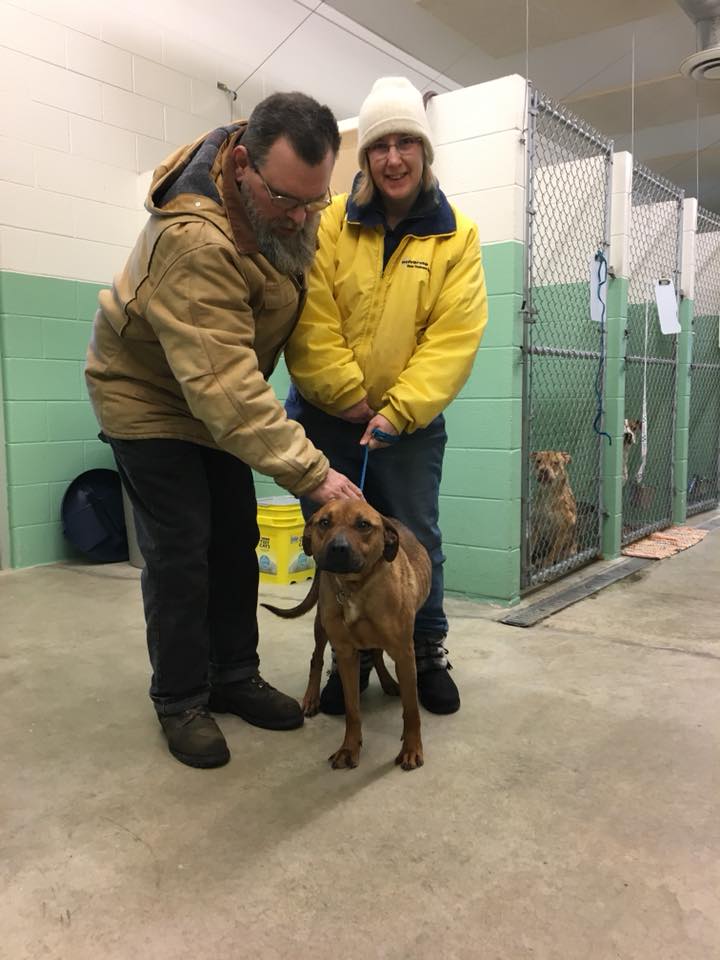
Hannah Joy (then called DeeDee) and two other dogs had been rescued from an owner who had starved them. They had sand in their stomachs from eating it to survive. They were so thin that we could have counted their bones. When EJ approached Hannah, she growled at him, but the staff person brought her out of her cage and she wrapped her front legs around his arm. And that was that. We had lost our dog, Danny, only a month before so EJ said before we left home, “We aren’t going to adopt today. We are just going to look.” Yeah, right. I knew there was no way we were coming home without a dog. So when we decided to adopt Hannah Joy, the staff person said, “I’ll get a leash for her,” I quickly said, “I already have my own” and pulled it out of my coat pocket. The staff person and EJ laughed at me. (FYI: The other two dogs were also quickly adopted by others.)
Because Hannah Joy had been abused, she had her quirks, but we fiercely loved her because of them, not despite them. They are what make her uniquely her. It is my opinion that it is not someone’s perfections, not the things about them that makes them fit in like everyone else, that makes them unique, but rather their quirks, idiosyncrasies, odd sense of humor, and flaws. I think that those are the things that are most missed when that someone is gone. It is true of humans and it is true of dogs.
Here are some of Hannah’s adorable quirks:
Not surprisingly, Hannah was obsessed with food. At first she gobbled food before I could get it in her dish. I taught her to sit and wait until I told her it was ok to start eating. We fed her twice a day–morning and evening–because otherwise she would ALWAYS want to eat. If she felt it was near dinner time, she’d start nagging me so eventually I set alarms on my phone to ring a bell (like Pavlov’s dog) and to say, “Are you hungry Hannah?” When she heard the alarm, she’d eagerly leap to her feet. The few times I was outside when the alarm rang (having left my phone inside and forgotten the time), she’d greet me with panic when I came back inside. Sorry, Hannah.
Like a goat, Hannah ate non-food items too. For awhile I didn’t have any nice wash cloths or dish rags because she chewed the edges into tatters. I learned to put them safely in drawers and put newly washed clothes away immediately rather than remain in laundry baskets. We had to put toilet paper out of her reach or I’d find toilet paper rolled across the floor or bitten into like a half-eaten apple. We had to buy cloth napkins because she’d snatch unattended paper ones. And she was skilled at sneaking kleenex from my pockets, as if she’d had criminal training. She was part pitbull. We called her our pit-pocket.
If we left Hannah Joy in the house alone, we had to make sure there was nothing she could get into. Even then, despite our best efforts, she sometimes found things to eat. She ate stuff we would never have guessed she could eat. For example, I always washed empty cat food cans to take to recycling. A year or so ago, I started finding Hannah chewing the cans. I thought I was absentmindedly not putting them out of her reach until I discovered she was stealing FULL cans, opening them, and eating the contents. I had to store the canned cat food in the pantry down the hallway rather than the kitchen.
I could tell when Hannah Joy was eating something she shouldn’t because she would quietly disappear–she usually was cuddling next to me–and I’d find her on our bed with her treasure. When she saw me coming, she’d turn and keep her back to me. She’d clamp her jaws together for a tug-of-war if I tried to take the item from her. Most of the time she won.
Hannah Joy refused to be ignored. She was very vocal and impatient. If she wanted something, she let me know that she wanted it NOW. If I ignored her, she’d keep grumbling and complaining. Sometimes she would climb on my lap, sit upright, and keep her head tilted back to block my face, no matter which way I turned, so I couldn’t see past her. “I know what you are doing, Hannah Joy,” I’d say, “and you aren’t getting it right now.” But, of course, she usually did.
Usually when Hannah Joy grumbled, she wanted outside or to go for a walk. “Ok, ok. Let’s go,” I’d say. Sometimes I’d ask her if she wanted out and she’d just sit down and look at me. I’d walk toward the bedroom and she’d run ahead of me and leap into bed. “It’s only 6 p.m., Hannah. YOU can go to bed if you want, but I am NOT.” Hannah hated to be apart from us, she loved cuddling, and she insisted on sleeping with us. Of course, she took her half out of the middle, pushing us to the sides. She loved burrowing under the blankets. If she was on top of the blankets, EJ and I never had enough blankets to pull over us so I finally bought a king-sized top sheet and comforter for our queen-sized bed so EJ and I would have enough to cover ourselves with.
Hannah never wanted to be outside alone. If I tethered her outside and went back inside, she’d come to the deck door and bark. When I went back outside, she’d quietly step off the deck and do her business. “You are SUCH a girl, Hannah Joy. Never wanting to go to the bathroom alone.”
A friend occasionally sent her a toy in the mail. So she thought every box was hers and tried to snatch them from me as we walked back up the driveway after getting the mail. “This is not yours, Hannah. Not yours.”
Hannah Joy was very protective and didn’t like strangers so we were careful who and how we introduced her. When strangers (such as a repairman) visited, we tried shutting her in the bedroom at first but she couldn’t endure being away from us and dug up the carpet under the door trying to get out. So more times than not I sat in the bedroom with her until the stranger was gone. If the stranger was a visiting friend, we learned to give the friend a bone when he/she entered the house to give to her. She’d take the bone and run off to chew it. By the time she was finished with the bone, she had accepted the stranger. Once she accepted a person, she loved him/her to pieces.
Hannah was NOT fond of cats, and we had two inside (and two outside) cats when she moved in with us. I’m sure that she was appalled when we agreed to care for JJ’s two cats until he can return from Alaska for them. This doubled our inside cat population to four. We had to work with Hannah Joy to get her to accept cats. She never liked them, but she did learn to tolerate them. Sometimes I’d show her videos of dogs and cats cuddling together. “This could be you, Hannah. The cats could be your friends.” She wasn’t impressed. Sometimes if a cat walked by, she’d shrilly bark and then quickly turn her head away, all innocent looking as if to say, “Wut? That wasn’t me.” “You know, Hannah, you are the ONLY ONE in the house who barks,” we told her. “You aren’t fooling us. We know it’s you.” Many times when a cat came near her, we’d say, “Be nice, Hannah. Be nice.” And she would calm down but turn her head away, obviously and deliberately not looking at the cat, occasionally giving them a side glance and then turning away. Whenever the cats did something Hannah thought was wrong, she’d come to me with a concerned look on her face to inform on them. One day I spun a story that Hannah tattles on the cats because she had had a rough early life and never had the opportunity to fulfill her dream of becoming a police dog.
Now, with her gone, we don’t have to put away wash cloths, toilet paper, or canned cat food. She’s not hogging the bed or the blankets. She’s not dragging us outside after dark (allowing us to sometimes hear owls or coyotes). We don’t have to remind her to be nice to the cats. I won’t have to stay with her in the bedroom when repairmen come to visit. She won’t gripe and complain until I give her what she wants NOW! She won’t come running at the ring of a bell. She won’t insist I go to bed with her at 6 p.m. But those quirks are the things we miss most. Those are the things that leave empty places in our hearts and our home.
There will never be another Hannah Joy. She brought us joy and her loss has hit us deeply.
The Power of a Dog
by Rudyard Kipling
There is sorrow enough in the natural way
From men and women to fill our day;
And when we are certain of sorrow in store,
Why do we always arrange for more?
Brothers and Sisters, I bid you beware
Of giving your heart to a dog to tear.
Buy a pup and your money will buy
Love unflinching that cannot lie—
Perfect passion and worship fed
By a kick in the ribs or a pat on the head.
Nevertheless it is hardly fair
To risk your heart for a dog to tear.
When the fourteen years which Nature permits
Are closing in asthma, or tumour, or fits,
And the vet’s unspoken prescription runs
To lethal chambers or loaded guns,
Then you will find—it’s your own affair—
But…you’ve given your heart to a dog to tear.
When the body that lived at your single will,
With its whimper of welcome, is stilled (how still!).
When the spirit that answered your every mood
Is gone—wherever it goes—for good,
You will discover how much you care,
And will give your heart to a dog to tear.
We’ve sorrow enough in the natural way,
When it comes to burying Christian clay.
Our loves are not given, but only lent,
At compound interest of cent per cent.
Though it is not always the case, I believe,
That the longer we’ve kept ’em, the more do we grieve:
For, when debts are payable, right or wrong,
A short-time loan is as bad as a long—
So why in—Heaven (before we are there)
Should we give our hearts to a dog to tear?


 I Love To Go A Gardening
It’s hard to let go, isn’t it. As much of a pain in the butt they can be, sometimes the most difficult are the ones you remember forever.
LikeLike
I agree. Hannah Joy had such a strong personality but also a fiercely loving heart. There will never be another like her.
LikeLike