I Love To Go A Gardening
Growing Our Life in Northern Michigan
The Pond
We’ve had some very hot days in August, but the weather is cooling. In fact, it feels very autumnish. EJ remarked that autumn seems to be coming very early this year; I reminded him that we say that EVERY year.
EJ had a follow-up appointment with his doctor on August 13th. EJ’s symptoms are unusual so the doctor told him to get an x-ray in case it’s a spinal problem. (EJ injured his back decades ago and has chronic pain.) An appointment is not required so we just walked down to the radiology department for his x-ray. We had enjoyable conversations with the other people waiting. While EJ was being x-ray, I got to chatting with an elderly lady sitting next to me. She told me that two of her sons had been born at that hospital. Then she went on to tell me stories of her family history: Her great-great grandfather (I think. I might have lost count of the number of greats.) moved to the area from Pennsylvania with his wife and his six children. He used to own a 30-acre pond called Rugg Pond. The elderly woman told me that her mother was 9-years-old when her mother (the elderly woman’s grandmother) died and the girl went to live with her 80-year-old grandmother. There are still descendants in the area.
It’s really interesting listening to elderly people share their knowledge of the history of an area. I was interested to learn more of the history of the pond so when I got home, I asked Grok (X’s AI) to search books, newspapers, blogs, and other sources for the history of the pond. Here are the highlights:
The area around Rugg Pond has roots in 19th-century settlement and logging. The nearby ghost town of Rugg, originally established in 1867 as Rapid River (named for the township), was renamed in honor of pioneer Rolando Francis Rugg (1843–1908), a Civil War veteran who homesteaded there in 1876. Rugg, born in West Auburn, Susquehanna County, Pennsylvania, to David H. Rugg and Anna Eliza Lacey, moved to Michigan after the war, where he served as Kalkaska County Sheriff from approximately 1893 to 1897 (sources vary slightly on the exact terms, listing 1892–1896 or 1893–1897). He was described in contemporary accounts as “one of the ablest and most popular men” in the county, and his family background included ties to Ruggtown in Pennsylvania, a small settlement named for his relatives involved in local business.
The pond itself is named after the Rugg family, with Rolando F. Rugg as a prominent local businessman and figure in the area’s development. The town of Rugg grew along the Pere Marquette Railroad during the timber boom but declined after the harvest ended, becoming a ghost town by the early 20th century…
The modern history of Rugg Pond begins with the construction of its dam in 1904 by Ambrose E. Palmer, founder of the Kalkaska Light and Power Company. Local farmers assisted by hauling rocks and sediment to build the structure, which created the impoundment to generate hydroelectric power for the village of Kalkaska and surrounding areas. A powerhouse was erected at the site, and the dam initially served as a vital early source of electricity in northern Michigan. Historical photos from around 1905 show crews building the dam, highlighting its role in the region’s industrial growth.
Ownership changed hands over the decades: In 1950, it was acquired by Consumers Power (now Consumers Energy), and in 1953, it was sold to the County, which has managed it since as a natural area. Power generation ceased long ago, and by the 2020s, the dam faced sediment buildup and condemnation, leading to public discussions about its removal to restore the river’s natural flow. In 2025, Kalkaska County received a $1 million grant for the removal process, with tours held for potential contractors. A historical marker at the site commemorates the dam’s role in early hydroelectric power.
Rugg Pond is linked to American author Ernest Hemingway through local legend. Hemingway, who spent summers in northern Michigan as a youth, reportedly spent a night fishing from the Rugg Pond dam powerhouse in June (likely during the 1910s, based on his known visits to the region). This story appears in county histories, Wikipedia entries of the county, and the JFK Library’s Hemingway Reference Collection, which includes a photograph of the powerhouse remains as the site of his overnight fishing. While not directly mentioned in Hemingway’s fiction (such as The Nick Adams Stories, inspired by Michigan rivers), the tale aligns with his documented trout fishing in areas like the Rapid River.
The elderly lady told me about the plans to remove the dam and said she wasn’t sure how that would effect the pond if they did. On the way home, EJ said we should take some photos of the pond before they destroyed the dam so we stopped in at Rugg Pond this week. Here’s one photo that EJ took:
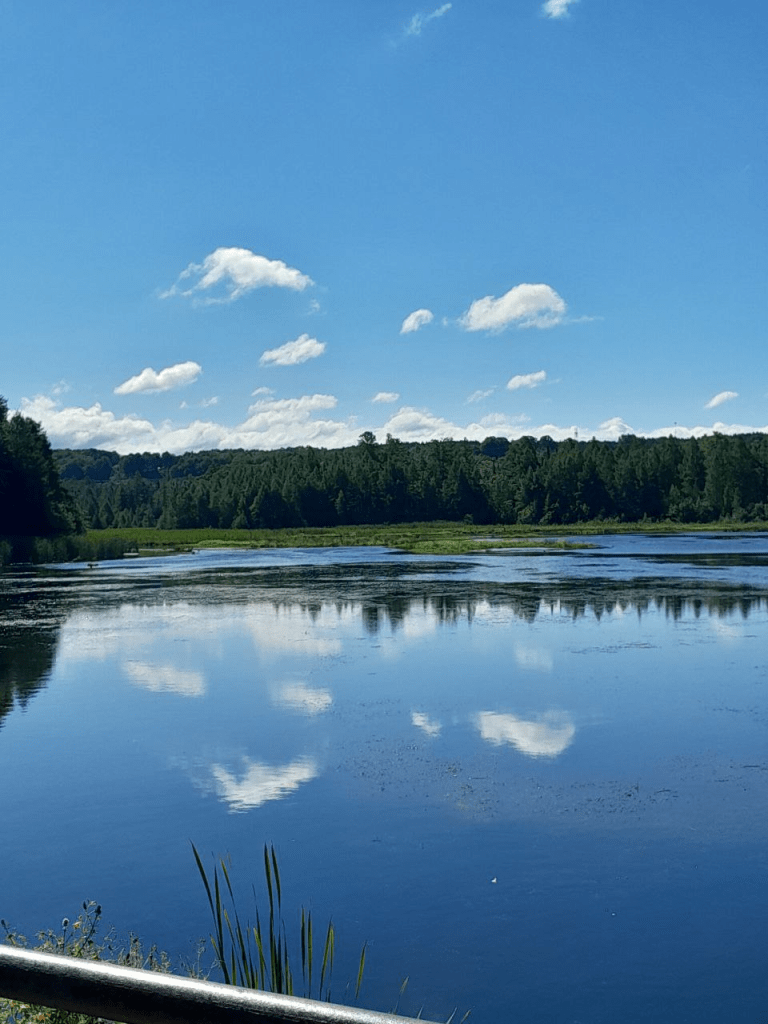
EJ took Monday off so he ended up with a four day weekend. (He works four 10-hour days and gets three days off.) and we did a few tasks around the house. I searched FB Marketplace and found an entry of straw for sale that met our criteria: relatively inexpensive and nearby. We went on a beautiful 20-mile drive to pick up 8 bales from the young guy selling it. The next morning, EJ unloaded the straw and carried it out to the coop, and I arranged it. We decided we could use more straw, so we messaged the guy that we wanted 8 more bales. He said he had 10 bales left and asked if we wanted them all. We replied that we’d take them if we could fit them in the truck. When we got to our destination, the guy said he had miscounted and actually had 12 bales. EJ said we’d take them all. I didn’t think we could fit them all in the truck–I thought our max was 8–but EJ moved the spare tire into the back seat of the truck and with careful arrangement, got them all to fit.
The next morning EJ unloaded the additional bales. I put several more in the coop–it insulates the coop in the winter. With the remaining bales we built a straw “castle” in the garage for Theo. We arranged the bales around an old cooler so Theo will have a warm shelter this winter. I’ve already seen him sleeping on the top of his castle so it appears he approves. In the Spring, EJ will dismantle the castle and use the straw to mulch his garden.
We get out of bed each morning at 4 a.m. This morning Hannah wanted out at 4:30 a.m., so I put her harness and leash on her and we took her out. During the day I fasten her to her tether, but I always put her on her leash at night so I can quickly pull her in the house if there are wild critters around–like skunks, coyotes, bobcats, or bears. EJ sat in a patio chair on the deck while I stood and held Hannah’s leash. All of of sudden, EJ exclaimed, “AHHH! Jeez!” He had glanced to his side and saw a white face in the bird feeder tray that was only a couple feet away and it startled him. A young possum was calmly sitting in the tray. We pulled Hannah into the house. She had noticed a cricket singing on a bush but she never saw the possum on the tray. It was dark but every now and then I shone a flashlight through the window to see if the possum was still there. It remained on the tray for a long time and I was getting concerned that maybe it was injured and wondered how I would deal with that situation. I’m glad the little possum was gone before it got light outside. I’m surprised it didn’t run when we went out on the deck. EJ theorized it was just a teenager possum doing dumb stuff.
We suspect this is the same young possum that almost got sprayed by a skunk, as seen in this video I put together with footage from my trail camera: Skunk and Young Possum
My trail camera also recently caught footage of a raccoon fight. Raccoons look like a cuddly stuffed animal until they get angry. Their conflict makes an exciting video, but it’s kind of unnerving and I’m glad we don’t see serious conflicts too often: Raccoon Fight.


 I Love To Go A Gardening